Aluminium Alloy
Aerospace aluminium alloys are widely used in the aerospace field by virtue of their unique advantages, such as low density, moderate strength, easy machining and forming, high corrosion resistance, abundant resources and high recyclability. The skins, beams, ribs, trusses, bulkheads and landing gears on aircraft can be made of aluminium alloy, while the crew cabin, forward fuselage, middle fuselage, rear fuselage, drogue, flaps, lifting and lowering aileron and horizontal tail of the space shuttle are all made of aluminium alloy. The amount of aluminium used in an aircraft varies according to its purpose. Focusing on economic benefits of civil aircraft due to the cheap price of aluminium alloy and a large number of adopted, such as the Boeing 767 airliner using aluminium alloy accounted for about 81% of the weight of the fuselage structure. Some aerospace aluminium alloys have good low-temperature performance, can work in liquid hydrogen and liquid oxygen environment, so it is a good material for manufacturing liquid rockets. Launch of the ‘Apollo’ spacecraft ‘Saturn’ No. 5 launch vehicle levels of fuel tanks, oxidant tanks, between the box section, interstage section, the tail section and the instrumentation module are made of aerospace aluminium alloys.
At present, the aluminium alloy materials used in aviation civil aircraft mainly include: aluminium alloy castings, aluminium alloy forgings, large section aluminium alloy extrusion profiles, aluminium alloy plates and aluminium-lithium alloys.
2024 aerospace aluminium alloy is used for aircraft structural parts. 2048 aerospace aluminium alloy is mainly used in the manufacture of aerospace structural parts and weapon structural parts. 2218 is mainly used for aircraft engines and diesel engine pistons, aircraft engine cylinder heads, jet engine impellers and compressor rings. 2219 is used for aerospace rockets to weld oxidant tanks, supersonic aircraft skin and structural components.
7049 is used for aircraft and missile parts, such as landing gear hydraulic cylinders and extrusions.7050 aerospace aluminium alloys are used for aircraft structural parts of medium and thick plates, extrusions, free forgings and die forgings.7178 aerospace aluminium alloys are used for the manufacture of aerospace vehicles that require high compressive yield strength.7475 is used for fuselage plates, wing skeletons, trusses, etc.7A04 is used for aircraft skins, screws and other structural components such as girders. Stressed components such as beam trusses, spacer frames, wing ribs, landing gear.
Titanium Alloys
Titanium alloy is an alloy composed of titanium with other elements added. Titanium has two types of homogeneous heterocrystals: α-titanium with a densely arranged hexagonal structure below 882°C and β-titanium with a body-centred cubic structure above 882°C.
Alloying elements can be divided into three categories according to their effect on the phase transition temperature:
① The elements that stabilise the α phase and increase the phase transition temperature are α-stabilising elements, such as aluminium, carbon, oxygen and nitrogen. Aluminium is the main alloying element of titanium alloy, which has obvious effects on improving the strength of the alloy at room temperature and high temperature, reducing the specific gravity and increasing the modulus of elasticity.
② Stabilisation of β-phase, reduce the phase transition temperature of the elements for the β-stabilising elements, and can be divided into homocrystalline and eutectic type two. The former has molybdenum, niobium, vanadium, etc.; the latter has chromium, manganese, copper, iron, silicon, etc..
③ The elements that have little effect on the phase transition temperature are neutral elements, such as zirconium and tin.
Oxygen, nitrogen, carbon and hydrogen are the main impurities in titanium alloys. Oxygen and nitrogen in the α-phase has a greater solubility, titanium alloy has a significant strengthening effect, but the plasticity is reduced. The content of oxygen and nitrogen in titanium is usually set at 0.15-0.2% and 0.04-0.05% respectively. Hydrogen in the α-phase solubility is very small, titanium alloys dissolved in excess of hydrogen will produce hydride, so that the alloy becomes brittle. Normally, the hydrogen content in titanium alloys is kept below 0.015%. The dissolution of hydrogen in titanium is reversible and can be removed by vacuum annealing.
Titanium is a new type of metal, titanium properties and the content of carbon, nitrogen, hydrogen, oxygen and other impurities, the purest titanium iodide impurity content of no more than 0.1%, but its strength is low, high plasticity. 99.5% of the performance of industrial pure titanium as follows: density ρ = 4.5g/cm3, melting point of 1725 ° C, the coefficient of thermal conductivity λ = 15.24W / (m.K), the tensile strength of σb = 539MPa. Elongation δ=25%, section shrinkage ψ=25%, modulus of elasticity E=1.078×10⁵MPa, hardness HB195.
High strength
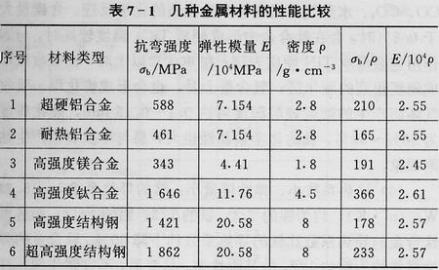
Comparative table of the properties of several metal materials
The density of titanium alloy is generally around 4.51g/cm3, only 60% of steel, some high-strength titanium alloy exceeds the strength of many alloy structural steel. Therefore, the specific strength of titanium alloy (strength/density) is much greater than other metal structural materials, can produce unit of high strength, good rigidity, lightweight parts. Titanium alloys are used in aircraft engine components, skeletons, skins, fasteners and landing gear.
High thermal strength
The use of temperature than the aluminium alloy a few hundred degrees higher in the medium temperature can still maintain the required strength, can be in the temperature of 450 ~ 500 ℃ long-term work of these two types of titanium alloys in the range of 150 ℃ ~ 500 ℃ is still very high than the strength of aluminium alloys in the 150 ℃ than the strength of the obvious decline. The working temperature of titanium alloy can reach 500℃, while aluminium alloy is below 200℃.
Good corrosion resistance
Titanium alloy in the humid atmosphere and seawater media work, its corrosion resistance is far better than stainless steel; pitting, acid corrosion, stress corrosion resistance is particularly strong; alkali, chloride, chlorine, organic items, nitric acid, sulfuric acid, etc. have excellent corrosion resistance. However, titanium has poor corrosion resistance to reducing oxygen and chromium salt media.
Good low temperature performance
Titanium alloy in low temperature and ultra-low temperature, can still maintain its mechanical properties. Good low-temperature performance, very low gap element titanium alloy, such as TA7, in -253 ℃ can also maintain a certain degree of plasticity. Therefore, titanium alloy is also an important low temperature structural material.
High chemical activity
Titanium is chemically active and has strong chemical reactions with O2, N2, H2, CO, CO2, water vapour, ammonia, etc. in the atmosphere. When the carbon content is greater than 0.2%, hard TiC will be formed in titanium alloy; when the temperature is higher, the role of N will also form a hard surface layer of TiN; above 600 ℃, titanium absorbs oxygen to form a hardened layer of high hardness; hydrogen content rises, will also form a brittle layer. Absorption of gas and produce hard brittle surface layer depth of up to 0.1 ~ 0.15 mm, the degree of hardening is 20% ~ 30%. Titanium's chemical affinity is also large, easy and friction surface adhesion phenomenon.
Thermal conductivity and elasticity is small
Titanium's thermal conductivity λ = 15.24W/(m-K) is about 1/4 of nickel, 1/5 of iron, 1/14 of aluminium, and the thermal conductivity of various titanium alloys is about 50% lower than that of titanium. The modulus of elasticity of titanium alloy is about 1/2 of steel, so its rigidity is poor, easy to deform, not suitable for making slender rods and thin-walled parts, and the rebound of the machined surface when cutting is very large, about 2 to 3 times that of stainless steel, resulting in intense friction, adhesion and bonding wear of the tool's rear blade surface.
High temperature alloy
High-temperature alloy refers to iron, nickel, cobalt as the basis, can be in the 600 ℃ above the high temperature and a certain amount of stress under the role of long-term work of a class of metal materials, with excellent high-temperature strength, good oxidation and thermal corrosion resistance, good fatigue properties, fracture toughness and other comprehensive performance, also known as ‘superalloys,’ the main applications in the The main applications are in the aerospace and energy fields.
High-temperature alloy refers to iron, nickel, cobalt as the basis, can be in the 600 ℃ above the high temperature and a certain amount of stress under the role of long-term work of a class of metal materials; and has a high high-temperature strength, good resistance to oxidation and corrosion, good fatigue properties, fracture toughness and other comprehensive performance. High-temperature alloys for a single austenitic organisation, in a variety of temperatures with good organisational stability and reliability.
Based on the above performance characteristics, and high-temperature alloy alloy degree of alloying, also known as ‘superalloys’, is widely used in aviation, aerospace, petroleum, chemical industry, ships, an important material. According to the matrix elements to points, high-temperature alloys are divided into iron-based, nickel-based, cobalt-based high-temperature alloys. Iron-based high-temperature alloys can only be used at a temperature of 750 ~ 780 ℃, for heat-resistant parts used at higher temperatures, the use of nickel-based and refractory metal-based alloys. Nickel-based high-temperature alloys in the entire field of high-temperature alloys occupies a special important position, it is widely used in the manufacture of aviation jet engines, a variety of industrial gas turbines, the hottest end of the components.
Traditionally, high-temperature alloys are classified in the following three ways: according to the type of matrix element, the type of alloy strengthening, and the way the material is shaped.
1、According to the type of matrix elements
(1) Iron-based high-temperature alloys
Iron-based high-temperature alloys can also be called heat-resistant alloy steel. Its matrix is Fe elements, adding a small amount of Ni, Cr and other alloying elements, heat-resistant alloy steel can be divided into martensitic, austenitic, pearlitic, ferrite heat-resistant steel and so on according to its normalisation requirements.
(2) nickel-based high-temperature alloys
Nickel-based high-temperature alloys containing more than half of the nickel content, suitable for working conditions above 1,000 ℃, the use of solid solution, aging process, can make the creep resistance and compressive yield strength increased significantly. On the high temperature environment to analyse the use of high-temperature alloys, the use of nickel-based high-temperature alloys range far more than iron-based and cobalt-based high-temperature alloys. At the same time nickel-based high-temperature alloys is also China's largest production, the largest use of a high-temperature alloy. Many turbine engine turbine blades and combustion chamber, and even turbocharger also use nickel-based alloy as a preparation material. More than half a century, the high-temperature materials used in aircraft engines to withstand high temperatures from the end of the 1940s 750 ° C to the end of the 1990s 1 200 ° C. It should be said that this huge increase has also contributed to the casting process and surface coatings and other aspects of rapid development.
(3) Cobalt-based high-temperature alloys
Cobalt-based high-temperature alloys are cobalt-based, cobalt content of about 60%, while the need to add Cr, Ni and other elements to enhance the heat-resistant high-temperature alloys, although this high-temperature alloys heat-resistant performance is better, but due to the production of cobalt resources in various countries is relatively small, the processing of the more difficult, and therefore the use of a small amount. Usually used in high temperature conditions ( 600 ~ 1 000 ℃ ) and a longer period of time by the limit of complex stress high temperature parts, such as aero-engine working blades, turbine discs, combustion chambers, hot end parts and aerospace engines and so on. In order to obtain better heat-resistant properties, general conditions in the preparation of elements such as W, MO, Ti, Al, Co, in order to ensure its superior thermal fatigue resistance.
2, alloy strengthening type
According to the type of alloy strengthening, high temperature alloys can be divided into solid solution strengthened high temperature alloys and aging precipitation strengthened alloys.
(1) solid solution strengthened
The so-called solid solution strengthened that add some alloying elements to iron, nickel or cobalt-based high temperature alloys, the formation of a single-phase austenitic organisation, solute atoms to make the solid solution matrix matrix distortion, so that the solid solution in the resistance to slip increased and strengthened. Some solute atoms can reduce the lamination energy of the alloy system, improve the tendency of dislocation decomposition, resulting in cross-slip difficult to carry out, the alloy is strengthened, to achieve the purpose of high temperature alloy strengthening.
(2) aging precipitation strengthening
The so-called aging precipitation strengthening that alloy workpiece by solution treatment, cold plastic deformation, placed at a higher temperature or room temperature to maintain its properties of a heat treatment process. For example: GH4169 alloy, the highest yield strength of 1 000 MPa at 650 ℃, the production of blade alloy temperature up to 950 ℃.
3、Method of material forming
Divided by material forming method: casting high-temperature alloys (including ordinary casting alloys, single crystal alloys, directional alloys, etc.), deformation of high-temperature alloys, high-temperature alloys, powder metallurgy (including ordinary powder metallurgy and oxide dispersion strengthened high-temperature alloys).
(1) casting high-temperature alloys
Using casting methods to directly prepare parts of the alloy material called casting high temperature alloys. According to the alloy matrix composition, can be divided into iron-based casting of high-temperature alloys, nickel-based casting of high-temperature alloys and cobalt-based casting of high-temperature alloys of three types. Divided by crystallisation, can be divided into polycrystalline casting high temperature alloys, directional solidification casting high temperature alloys, directional eutectic casting high temperature alloys and single crystal casting high temperature alloys, such as 4 types of types.
(2) deformation of high-temperature alloys
Still the most used materials in the aircraft engine, widely used at home and abroad, China's annual output of deformed high-temperature alloys for the United States is about 1 / 8 [2]. GH4169 alloy, for example, it is the most widely used at home and abroad, a major variety. China is mainly in the turboshaft engine bolts, compressors and wheels, oil disc as the main parts, with the increasing maturity of other alloy products, deformation of high-temperature alloys may gradually reduce the amount of use, but in the next few decades will still be dominant.
(3) new high-temperature alloys
Including powder high-temperature alloys, titanium and aluminium intermetallic compounds, oxide diffusion strengthened high-temperature alloys, corrosion-resistant high-temperature alloys, powder metallurgy and nanomaterials, and other niche product areas.
① third-generation powder high-temperature alloys alloying degree of enhancement, so that it takes into account the advantages of the first two generations, to obtain higher strength lower damage, powder high-temperature alloys are becoming more mature, the future may be carried out in the following areas: powder preparation, heat treatment process, computer simulation technology, dual-performance powder disc; ② titanium-aluminium intermetallic compounds.
③ oxide dispersion strengthened high temperature alloy is a part of the powder high temperature alloys, are in production and development of nearly 20 kinds of high-temperature strength and low stress coefficient, widely used in gas turbines heat-resistant oxidation parts, advanced aviation engines, petrochemical reactors and so on;
④ Corrosion-resistant high temperature alloys are mainly used to replace refractory materials and heat-resistant steel, applied in construction and aerospace field.
Commonly used types
1、GH4169 high temperature alloy
GH4169 alloy is nickel-chromium-iron-based high temperature alloy.GH4169 alloy belongs to nickel-based deformation high temperature alloy. Nickel-based alloy is one of the most complex alloys. It is widely used in the manufacture of various high temperature components. At the same time, it is also one of the most notable alloys among all high temperature alloys. It also has the highest relative service temperature of all common alloy families. The proportion of this alloy in advanced aircraft engines is above 50%.
GH4169 alloy is by the international nickel company Huntington branch of the Eiselstein development success, in 1995 the public introduction of age-hardening nickel - chromium - iron based deformation alloy. The alloy is body-centred cubic g’ and face-centred cubic g′ phase for precipitation strengthening of a nickel-based deformation of high temperature alloys, in the 650 ℃ below the high tensile strength, yield strength and good plasticity, with good corrosion resistance, radiation resistance, fatigue, fracture toughness and other comprehensive performance, as well as satisfactory welding and post-welding moulding properties, etc.. Alloy in -253 ~ 650 ℃ wide temperature range of organisational properties are stable, become in the deep cooling and high temperature conditions under the use of a very wide range of high temperature alloys. Due to the good overall performance of GH4169, it is widely used in aero-engine compressor discs, compressor shafts, compressor blades, turbine discs, turbine shafts, magazines, fasteners and other structural parts and plate weldments, etc. [3].
China began to develop GH4169 alloy in the 1970s, mainly used in disc parts, the use of time is relatively short, so the use of vacuum induction plus electroslag remelting dual process. In the eighties, it began to be applied in the field of aviation, and the improvement and enhancement of the material quality, the comprehensive performance of the alloy and the reliability of use became the main research direction. The current main research direction of GH4169 alloy is:
(1) improve the smelting process, quantify the smelting parameters, to achieve stable operation of the program, so that the microstructure of the alloy is more uniform, so as to obtain excellent yield and fatigue strength and resistance to crack extension stopping ability to improve the low-week fatigue strength and so on;
(2) Improve the heat treatment process. Heat treatment process can not well eliminate the segregation in the centre of the ingot, so it has a negative impact on the uniformity of the organization, so the use of reasonable homogenisation annealing process to get fine crystal billet has become one of the main research directions;
(3) Improvement of use design. As the working temperature of GH4169 can not be higher than 650 ℃, so the cooling of the parts should be strengthened to give full play to the advantages of this high-temperature alloy such as high performance and low cost;
(4) Improve the organisational stability. Due to the long life requirements of aero-engine components, it is also crucial to improve the long-term aging organisational stability of GH4169 alloy.
2, single crystal high temperature alloys
Single-crystal alloy materials have been developed to the fourth generation, temperature capacity to 1140 ℃, has been close to the temperature limit of metal materials. In the future to further meet the needs of advanced aircraft engines, blade development materials to further expand, ceramic matrix composite materials are expected to replace the single crystal high temperature alloy to meet the hot end parts in the use of higher temperature environment.
Monocrystalline high temperature alloy blade development difficulties and cycles related to its structural complexity, ordinary complexity of the single crystal blade development cycle is shorter, but also in the application of aircraft engines need to experience a longer period of time. From single-crystal solid blade to single-crystal hollow blade, to high efficiency air-cooled complex hollow blade, etc., the technical difficulty span is very large, the corresponding development cycle span is also larger. General a common level of complexity of monocrystalline hollow blade from the drawing confirmation, mould design to trial production, and then to a small batch of production, it takes 1 to 2 years. But the single crystal blade due to its complex service environment, the need for a large number of verification tests, generally an ordinary structure of the single crystal hollow blade from the development of the application of the aircraft engine after 5 to 10 years, some with the engine development progress, and even need 15 years or longer.
Main applications
1、Aerospace field
China's development of independent aerospace industry to develop advanced engines, will bring the market demand for high-end and new high-temperature alloys.
Aero-engine is known as the ‘flower of industry’, is the aviation industry, the highest technical content, one of the most difficult components. As the aircraft power plant of the aero-engine, especially important is the metal structure material to have a lightweight, high strength, high toughness, high temperature, oxidation, corrosion and other properties, which is almost the highest structural material performance requirements.
High-temperature alloys are metal materials that can work for a long time above 600℃ and under certain stress conditions. High-temperature alloys are developed to meet the harsh requirements of modern aero-engine materials, and have become an irreplaceable class of key materials for aero-engine hot-end components. In advanced aero-engines, the proportion of high-temperature alloys has reached more than 50%.
In modern advanced aero-engine, high temperature alloy materials accounted for 40% to 60% of the total engine. In the aero-engine, high-temperature alloys are mainly used in the combustion chamber, guide vanes, turbine blades and turbine discs of the four major hot parts; in addition, it is also used in the magazine, ring parts, fuel combustion chamber and tail nozzle and other parts.
2、Energy field
High-temperature alloys have a wide range of applications in the field of energy. Coal power with high parameters of ultra-supercritical power generation boilers, superheaters and re-superheaters must use good creep resistance, in the steam side of the oxidation resistance and corrosion resistance in the flue gas side of the high temperature alloy tubes; in the gas turbine gas turbine, turbine blades and guide blades need to use high-temperature corrosion resistance and long-term organization of the stability of the anti-thermal corrosion of high-temperature alloys; in the field of nuclear power, the steam generator heat transfer pipe In the field of nuclear power, the steam generator heat transfer tube must be selected to resist solution corrosion of good high temperature alloys; in the field of coal gasification and energy saving and emission reduction, the extensive use of high-temperature thermal corrosion and high-temperature abrasion resistance of high-temperature alloys; in the oil and natural gas mining, especially in deep-well mining, the drilling tool is in the 4-150 ℃ of the acidic environment, coupled with the presence of CO2, H2S and silt and sand, etc., it is necessary to use corrosion and wear resistance of high-temperature alloys [5].
China's Shanghai Electric, Dongfang Electric, Harbin Turbine Works and other large-scale power generation equipment manufacturing group in the production scale and production technology and other aspects in recent years has improved, pulling the demand for power generation equipment with the turbine disc. Are being developed a new generation of power generation equipment - large-scale ground combustion engine (also available as ship power) has made significant progress, the realization of mass production will drive the demand for high-temperature alloys. At the same time, the localisation of nuclear power equipment, will also drive the demand for domestic high-temperature alloys.
Composite Materials
Definition
Composite material has two meanings: broadly speaking, it refers to a solid material consisting of two or more physical phases. Examples include: fibre-reinforced polymers, reinforced concrete, asbestos-cement sheets, rubber products, triclosan, etc. In a narrower sense, it refers to plastic, metal and ceramic materials reinforced with high-performance glass fibres, carbon fibres, boron fibres, aramid fibres and so on.
The International Organisation for Standardisation had defined composites in the definition of plastic nomenclature as ‘a multiple system obtained by combining two or more physically and chemically different substances.’ It follows that composites should be multinomial systems; and their combination must have a composite effect.
Comparison
There are three significant differences between advanced composites and traditional metallic materials:
1. structural design has shifted from various isotropic metallic material designs to orthogonal anisotropic layup optimisation designs.
2. Forming of structural components is done simultaneously with material forming, and manufacturing plays an important role.
3. Material properties are significantly affected by environmental factors (moisture/heat, impact) and damage modes are diversified.
Classification
Classification according to the type of matrix material
According to the type of matrix material can be divided into organic material-based, inorganic non-metallic material-based and metal-based composites of three major categories, according to the type of organic material can be divided into resin-based, rubber-based and wood-based; according to the type of resin and thermosetting resin-based and thermoplastic resin-based; according to the type of inorganic non-metallic material can be divided into glass-based, ceramic-based, cement-based and carbon-based; according to the type of ceramics and alumina-based, zirconia-based, quartz glass-based, etc.; according to the type of metal can be divided into aluminium-based, copper-based, magnesium-based and titanium-based.
Classification according to the type of reinforcement
According to the geometry of the reinforcement can be divided into particle-enhanced, fibre-enhanced and plate composites of three major categories; according to the size of the particle size can be divided into two categories of diffuse and particle-enhanced; according to the length of the reinforcing fibres can be divided into continuous fibre-enhanced and discontinuous reinforced two major categories; according to the length of non-continuous fibres and short fibre reinforced and whisker-enhanced; according to the arrangement of the short fibres in the composites According to the arrangement of short fibres in the composite material, there are random arrangement and directional arrangement; according to the types of fibres can be divided into glass fibre reinforced, carbon fibre reinforced, aramid fibre reinforced, alumina fibre reinforced, zirconia fibre reinforced, quartz fibre reinforced, potassium titanate fibre reinforced and wire reinforced, etc.; and according to the types of metal wire can be divided into tungsten, aluminium, stainless steel, etc.; according to the different reinforcing materials of the laminates can be divided into paper fiber According to the different reinforcing materials of laminates, they can be divided into paper fibre laminates, cloth fibre laminates, wood fibre laminates, asbestos fibre laminates and so on.
Stainless Steel
Stainless steel materials are an important material widely used in the aerospace field, mainly those with high strength, good toughness, excellent corrosion resistance and high temperature resistance. These properties make aviation stainless steel materials have an irreplaceable position in the aerospace field.
Characteristics
. High strength and good toughness: this makes aerospace stainless steel materials can withstand the enormous pressure and vibration generated by aircraft and spacecraft in flight, ensuring the safety and stability of the structure1.
. Excellent corrosion resistance: in the aerospace environment, the material may come into contact with a variety of corrosive media, such as fuels, oxidisers and so on. Aerospace stainless steel materials are able to maintain long-term stability and reliability in these harsh environments due to their excellent corrosion resistance12.
. High temperature resistance: the aerospace field has very high requirements for the high temperature resistance of materials. Aerospace stainless steel materials can maintain sufficient strength at high temperatures and are not easily deformed or melted, thus ensuring the normal operation of aircraft and spacecraft.
In the aerospace field, aviation stainless steel materials are widely used in the manufacture of aircraft and spacecraft structural parts, engine components, combustion chambers and other key parts. For example, 301 stainless steel and 304L stainless steel are two commonly used aerospace stainless steel materials, which have high strength and good toughness as well as excellent corrosion resistance, respectively.1 In addition, there are also stainless steel materials like S17700, which are also widely used in the aerospace field due to their high temperature strength and corrosion resistance properties 3.
Overall, aerospace stainless steel materials play a pivotal role in the aerospace field by virtue of their unique performance advantages. With the continuous progress of technology and material innovation, the application prospect of aviation stainless steel materials will be more broad.
High strength steel
Aerospace high strength steel is a class of steel with ultra-high strength, excellent toughness and fatigue resistance and other characteristics, is widely used in the aviation manufacturing industry. The following is a detailed introduction about aerospace high strength steel:
Definition and Characteristics
Aerospace high-strength steels are generally defined as steels with a tensile strength greater than 1400 MPa and a yield strength greater than 1200 MPa at room temperature.
These steels not only have high strength, but also show excellent impact toughness, corrosion resistance, fatigue fracture resistance and stress corrosion resistance.
Types and Applications
A100 steel: As a high-performance ultra-high-strength steel material in the aerospace manufacturing industry, A100 steel is widely used in key parts such as the main bearing members of aircraft landing gears, wing main beams, and flat-tailed spindles, thanks to its excellent performance2.
MS1180 high strength steel: In the aerospace field, MS1180 high strength steel has become an ideal choice for manufacturing key components such as aircraft landing gear and engine mounts due to its excellent mechanical properties and fatigue resistance3.
300M steel: This is a medium-carbon, low-alloy, ultra-high-strength steel with high hardenability and temper resistance, as well as excellent transverse plasticity, fracture toughness and fatigue resistance. It is widely used as landing gear material for U.S. military aircraft and major civil aircraft, such as military fighters like the F-15 and F-16, and civil aircraft like the Boeing 747.45
4340 steel: As a typical representative of low-alloy ultra-high-strength steel, 4340 steel has very good hardenability, strength and toughness, as well as high fatigue strength and low notch sensitivity. It is mainly used in aircraft for the manufacture of parts such as main starting shock absorber outer barrels and piston rods5.